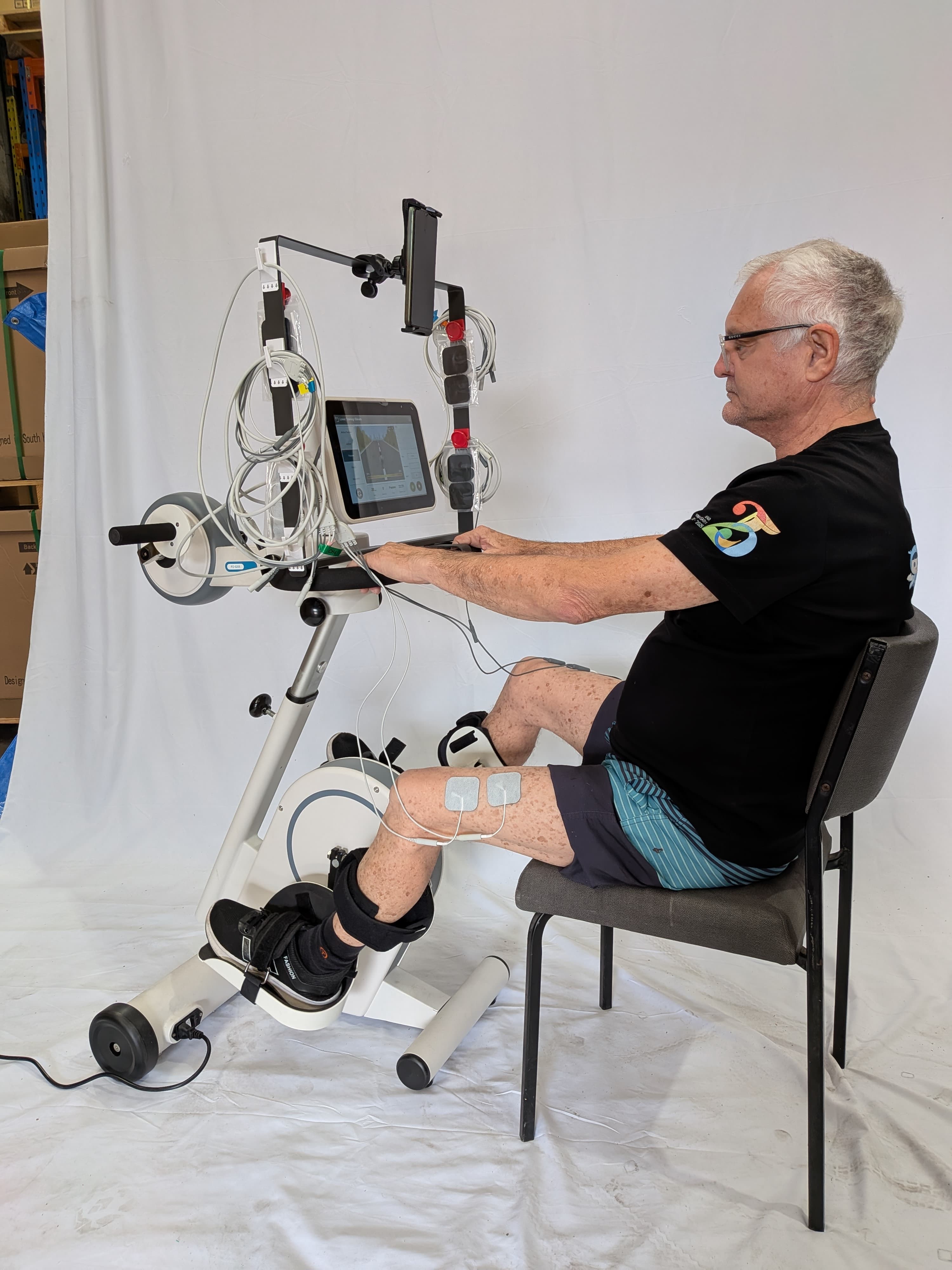
Functional electrical stimulation (FES) combined with a motor-assisted pedal or crank trainer is a well-recognised approach in neurological and orthopaedic rehabilitation — yet in New Zealand the number of integrated FES pedal machines you can source locally remains small. For many clinics the practical choice has been either a standard arm/leg trainer or a separate NMES unit wired alongside it, with timing and setup left to the therapist each session.
That landscape is shifting. FES-enabled trainers are still a relatively new category here compared with long-established active–passive floor units and chair-side cycles, but demand is growing as teams look for better ways to support weak or paretic muscle groups during rhythmical limb work. This article outlines the NZ context, how FES complements the trainer itself, and why the combination often outperforms movement alone when the clinical goal is functional recruitment — not just joint excursion.
FES pedal machines in New Zealand
Overseas catalogues list several premium FES cycling platforms, but local availability, demo access, spare parts, and after-sales support narrow what most NZ physiotherapy departments and private practices can realistically adopt. Import lead times, currency, and servicing from distant distributors add friction — especially when you need a machine that will run daily across inpatient, outpatient, and home settings.
Integrated systems — where stimulation channels, pedal timing, and training modes share one control interface — are newer on the NZ market than conventional motorised exercisers. That relative newness means fewer reference sites in-country, but it also means teams adopting now are not locked into decade-old hardware. Clinicians who already use standalone TENS or NMES for isolated muscle work may find an all-in-one FES trainer a more efficient next step when cycling is the primary dose.
Supapedal Ultra FES — key features
The Supapedal Ultra FES is one of our latest products. It extends the Supapedal Ultra platform with coordinated functional electrical stimulation built into the same control interface as the trainer — so stimulation timing, training mode, and session parameters are managed together rather than across separate devices.
- FES integrated with pedalling — evoked contractions timed to crank position during upper- or lower-limb work.
- Multiple training modes — passive, active, assistive, active+passive combination, and isokinetic (constant speed).
- Arms and legs — dual-function design with adjustable upper-limb rotation (0°–180°) and flip (90°) for positioning.
- Speed and resistance — ~5–60 rpm and resistance grades 1–12 for active work.
- Programmable sessions — duration from 1–99 minutes to match treatment plans and tolerance.
- Touchscreen interface — modes, metrics, and FES setup on a single display for carer-led sessions in clinic or supervised home use.
The Ultra FES is suited to hospitals, physiotherapy clinics, and supervised home programmes where neurological, orthopaedic, or mobility-related rehabilitation includes FES as part of the care plan.
How FES complements the trainer
A motor-assisted trainer moves the limb through range — valuable for maintaining joint mobility, encouraging circulation, and providing sensory input. On its own, however, passive or lightly assisted cycling may not elicit meaningful contraction in muscles that are weak, inhibited, or poorly recruited after spinal cord injury, stroke, multiple sclerosis, or cerebral palsy.
FES adds timed, task-specific muscle activation within each revolution: quadriceps and hamstrings (or elbow flexors and extensors on upper work) can be stimulated in sequence with the crank position so contraction aligns with the biomechanical demand of pedalling. That coupling is the clinical distinction between “stimulation on the leg” and FES cycling.
- Recruitment when voluntary drive is low — the trainer supplies motion; FES helps target muscles that would otherwise ride passively on the crank.
- Sensory-motor coupling — repeated contraction during a functional rhythm may support re-education better than isolated twitches on a couch.
- Assistive and active modes — as voluntary effort returns, stimulation can be reduced or phased so the session progresses from supported to more independent work on the same device.
- Workflow — one integrated system replaces juggling separate stimulator leads, tape, and cycle timers, which matters when session time is short and carer ratios are tight.
For definitions of FES versus TENS and EMS/NMES, see our FES, TENS and EMS overview.
FES plus trainer vs. trainer alone
A leg or arm trainer without FES still has clear roles: early mobilisation, range maintenance, oedema management, and cardiovascular loading when the person can contribute active effort. When the limiting factor is muscle activation rather than joint stiffness alone, movement without evoked contraction may under-deliver on the training stimulus you intend.
| Aspect | Trainer alone | FES + trainer |
|---|---|---|
| Muscle work per revolution | Depends on voluntary effort; passive modes may move joints with minimal contraction | Evoked contractions timed to crank phase add structured work in target muscles |
| Neurological populations | Useful for mobilisation; weak limbs may follow the crank without active contribution | Supports activation in paretic groups while preserving rhythmical, task-based context |
| Cardiovascular load | Increases with active participation; passive-only work is typically lighter | Additional muscle pump from FES can raise metabolic demand even when assist is high |
| Clinical setup | Single device; straightforward dosing by time and mode | Integrated timing reduces ad-hoc electrode and stimulator management during cycling |
In short: the trainer supplies movement and dose structure; FES supplies targeted activation within that movement. Neither replaces assessment, goal-setting, or contraindication screening — but together they address a gap that a conventional arm/leg cycle leaves open when voluntary recruitment is the main barrier to progress.
Safety and scope
FES cycling carries the same electrotherapy precautions as other NMES applications (e.g. active DVT in the treated limb, implanted devices without clearance, broken skin under electrodes — follow local protocols and the manufacturer IFU). Programme selection, electrode placement, and intensity remain the responsibility of the treating clinician. This article is for orientation only and does not replace device manuals or individual assessment.
Supapedal Ultra FES
Specifications, gallery, and enquiry details for our FES-enabled Ultra trainer are on the product page below.
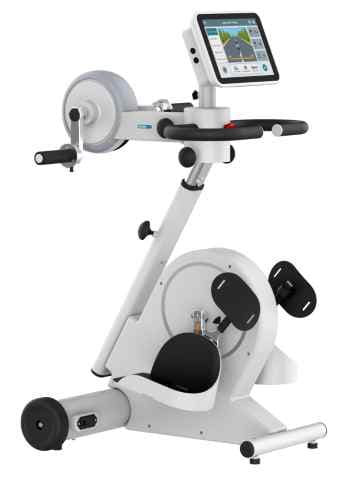
Supapedal Ultra FES
Motor-assisted and active training for arms and legs with functional electrical stimulation (FES)—multiple modes, programmable sessions.
- FES plus passive, active, assistive, and isokinetic modes
- Adjustable speed, resistance, and session time
- Arms and legs; adjustable upper limb angles
- For hospitals, clinics, and home